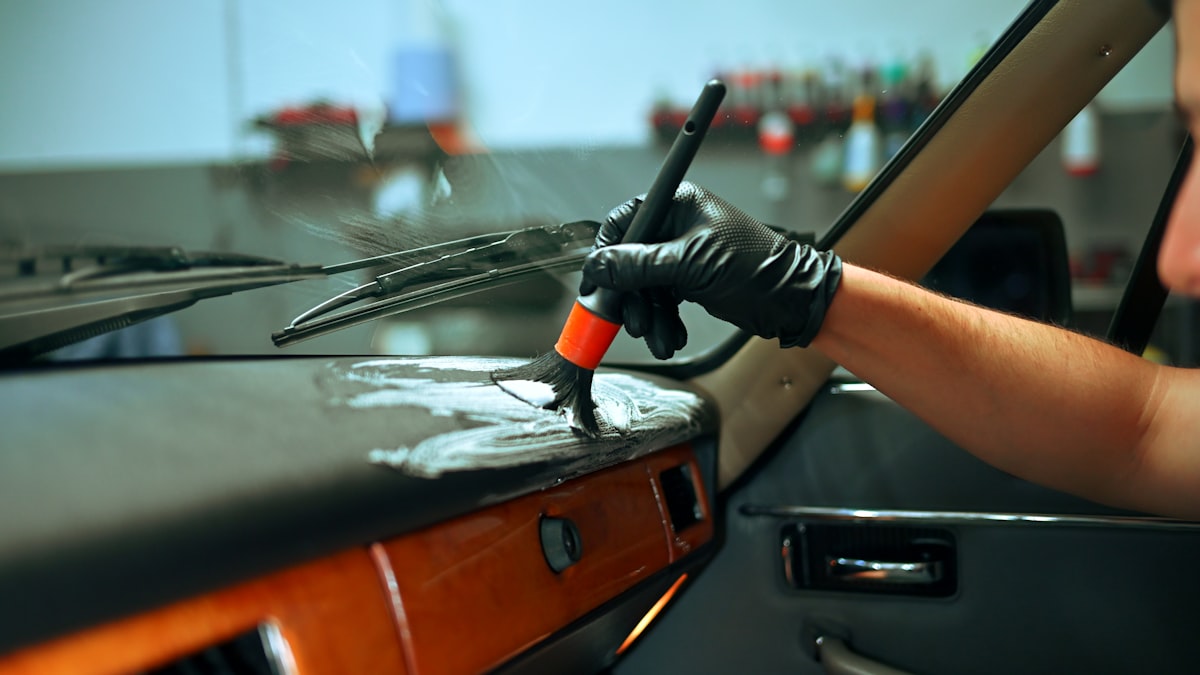
Short answer: A sticky dashboard is usually plasticizer migration — a chemical compound inside the soft-touch coating breaking down from heat and UV and rising to the surface as residue, not something you spilled. A sticky cup holder or console tray is almost always dried, layered soda and coffee residue. A sticky door panel is typically old dressing product or hand contact grime built up over years. Cleaning them takes different approaches, and the DIY fix for one can actually make another worse. Below is what actually works for each, and when the residue is deep enough that a proper interior clean does more than another spray bottle will.
Search "why is my car's interior sticky" and most of what comes back treats the dashboard, the cup holders, and the door panels as the same problem with the same fix — usually "spray it and wipe it." They're not the same problem. A dashboard's soft-touch coating is a different material doing a different chemical thing than a hard plastic cup holder collecting spilled soda, and a door panel armrest is picking up something else again. Here's what's actually happening on each surface, what removes it without damaging the finish, and where DIY genuinely stops working.
What's Actually Causing the Stickiness
Most dashboards, door panel tops, and console lids built in the last 15 years use a soft-touch polymer coating — the slightly rubbery texture that feels nicer than bare plastic. That coating is made soft and flexible with plasticizers, chemical compounds blended into the polymer during manufacturing. Plasticizers aren't permanently bonded to the material; they're distributed through it, and under enough heat and UV exposure they migrate outward and sit on the surface as an oily, sticky film. This is a known failure mode across dashboard plastics from a wide range of manufacturers, not a defect specific to one brand or a sign anything is broken.
Cup holders and console trays are a different mechanism entirely: dried sugar and acid residue from soda, coffee, and juice. Sugar doesn't fully evaporate — it dries into a thin, tacky film that re-hydrates and gets stickier again with humidity or a fresh drop of condensation from a cold cup. Every spill that isn't wiped immediately adds another layer.
Door panel armrests and pull handles usually come down to a mix of hand oils, old silicone-based interior dressing that was sprayed on and never fully absorbed, and dust that's bonded to both. It's slower to build than a cup holder spill but just as real after a couple of years of daily contact.
Don't reach for WD-40 or straight vinegar on any of these. WD-40 is petroleum-based and can soften or discolor soft-touch plastic, leaving an oily residue that's arguably worse than what you started with. Vinegar's acidity, used repeatedly, can dull the factory UV coating on some soft-touch dashboards. A proper interior cleaner or a light isopropyl alcohol solution breaks the residue down without attacking the material underneath.
Dashboard vs. Cup Holders vs. Door Panels: What Actually Fixes Each
| Surface | Real cause | What works | What to avoid |
|---|---|---|---|
| Dashboard / soft-touch trim | Plasticizer migration from heat + UV | Interior-specific cleaner on a microfiber towel, gentle pressure, multiple light passes rather than one hard scrub | Magic Eraser (dulls the coating), silicone dressings (temporarily masks it, then attracts more dust) |
| Cup holders / console tray | Dried sugar and acid film from drinks | Warm water with a drop of pH-neutral soap, soft detail brush to work into the ridges, then a dry wipe | Undiluted alcohol on painted plastic trim (can strip the finish), soaking — it can seep into electronics below |
| Door panel armrest / handle | Hand oils + old dressing + dust buildup | Interior cleaner, soft brush on textured grips, condition afterward with a matte (not glossy) protectant | Glossy "tire shine"-style dressings — they look wet and grab dust within a day |
How to Clean Each Surface Without Making It Worse
- Vacuum first, always. Loose dust, crumbs, and pet hair turn into a gritty paste the moment they meet any liquid cleaner, and that paste is what actually scratches soft plastic — not the cleaner itself.
- Spray the cleaner onto the towel, not the surface. Direct spray can pool into seams, vents, or electronics below cup holders and console trays. A damp towel gives you control over exactly where the product goes.
- Work in small sections with light pressure and multiple passes. Residue lifts in layers. Pressing hard once does less than three light passes, and it's what causes visible dull patches on soft-touch coatings.
- Get into ridges and seams with a soft detail brush. Cup holder ribbing and door panel texture trap residue a flat towel can't reach — a cheap, soft-bristle brush (an old toothbrush works) gets into those without scratching.
- Dry with a clean microfiber towel immediately after. Leaving any cleaner to air-dry on its own redeposits whatever was dissolved back onto the surface as a new film — the exact layering problem you're trying to fix.
- Condition soft-touch surfaces with a matte protectant, sparingly. A light matte finish helps resist future residue buildup. Skip glossy "shine" products entirely — they look good for a day and then act as dust and lint magnets.
The Bay Area Heat Factor
Dashboard surfaces in a parked car regularly hit 160–180°F on a sunny day, and the Bay Area's clear, low-humidity summers mean cars here spend more days than most of the country baking under direct, unfiltered sun — especially anything parked outdoors without shade, which describes most street parking and a large share of apartment and condo lots across the region. That heat and UV load is the direct accelerant for plasticizer migration, which is why a car that's spent three summers in an uncovered lot can look years older on the dashboard than an identical car that's been garaged. A windshield sunshade on hot days is the single cheapest thing that slows this down — it's not a fix for stickiness that's already there, but it buys real time before it comes back. See our full Bay Area pricing guide for what an interior deep clean actually runs once it's past the DIY stage.
Common Mistakes That Make It Worse
- Layering spray after spray without ever fully removing what's underneath. Each application that isn't followed by a real wipe-down adds to the residue instead of replacing it.
- Using glossy interior dressings on the dashboard. They look good in the store display and attract dust the moment you park — within a day the "clean" look is gone and there's a new sticky layer underneath it.
- Scrubbing hard with an abrasive pad on soft-touch trim. It can permanently dull the texture and leave lighter patches where the coating itself has been worn down, which no cleaner reverses.
- Ignoring cup holders until they're visibly gummy. A weekly quick wipe takes 30 seconds. Months of layered soda residue can take real dwell time and scraping to fully lift.
When It's Beyond a Wipe-Down
If the stickiness covers the dashboard, console, door panels, and seats together — not just one high-traffic spot, and possibly alongside set-in seat stains — that's usually years of layered residue across the whole cabin, not a single afternoon's spill. At that point, spot-cleaning one surface at a time barely keeps pace, because everything you're wiping is re-depositing dust onto the sections you already cleaned. Our full interior deep clean covers every surface in one pass — dashboard, console, door panels, seats, and carpets — with dwell time and proper extraction on anything a spray-and-wipe can't fully lift, which is the difference between a cabin that looks clean for a day and one that's actually reset. For a car that sees a drink in the cup holder every day, the monthly membership keeps residue from ever getting to this point instead of paying for one big reset every few years.
Be honest with yourself about one thing: no cleaning, ours or DIY, repaints or re-textures a dashboard that's already visibly cracked, faded, or worn through the coating from years of sun exposure. That's a restoration and refinishing job, and it's not a service XN offers — we clean and condition what's there, we don't repaint plastic. If your dashboard's texture is physically degraded rather than just residue-covered, cleaning will make it look better but won't reverse the material damage underneath.
The products we actually use
For dashboard and door panel soft-touch surfaces, we use Chemical Guys interior cleaners applied to a microfiber towel — never sprayed directly — specifically because direct spray on soft-touch trim is how product ends up pooled in vents and seams. Cup holders and console trays get a warm water and pH-neutral soap solution worked in with a detail brush, since a full solvent-based cleaner is overkill for dried sugar residue and can be harsher than it needs to be on painted plastic. Leather trim pieces near the console are conditioned with Meguiar's leather conditioner, which restores flexibility rather than just wiping the surface. None of this includes a coating, sealant, or long-term protective layer for interior plastic — that's not something we offer, and any product that claims to permanently stop plasticizer migration on soft-touch trim is overselling what a topical treatment can actually do.
Frequently Asked Questions
Does WD-40 or vinegar remove sticky dashboard residue?
Skip both. WD-40 is a petroleum-based lubricant that can soften or discolor some vinyl and soft-touch plastics, and it leaves its own oily film behind — you'd trade one sticky surface for a slippery, hazy one. Vinegar's mild acidity can dull the factory UV coating on certain soft-touch dashboards over repeated use. A dedicated interior cleaner or a light isopropyl alcohol solution breaks down the residue without attacking the material underneath.
Is it safe to use a Magic Eraser on a sticky dashboard?
Not on soft-touch or textured dashboard plastic. A Magic Eraser is mild abrasive foam, and on a textured or coated surface it can dull the finish and leave visibly lighter patches where you scrubbed hardest. It works fine on hard, glossy plastic like some door handles or console trim, but test an inconspicuous spot first and never use it on leather or anything with a grained texture.
Why does my dashboard get sticky again a few weeks after I clean it?
Two reasons, and they compound. First, most interior sprays and wipes leave a microscopic residue layer that never fully evaporates, and each application adds another coat on top of the last one. Second, if the stickiness is plasticizer migration rather than surface grime, cleaning removes what's currently on top but the material keeps releasing more from underneath as heat and UV exposure continue. That's why a full residue strip, not another spray-on treatment, is what actually resets the surface.
Does a sticky dashboard mean something is mechanically wrong with my car?
Almost always no — it's a surface issue, not a mechanical one. The one exception worth ruling out: a sweet, slightly fruity smell along with the stickiness can point to a slow coolant leak from the heater core misting onto interior surfaces, which is a repair issue, not a cleaning one. If you notice that smell alongside the residue, get the cooling system checked before you spend more time cleaning.
How often should I clean sticky interior surfaces to keep them from coming back?
A quick wipe-down every 2-3 weeks with a proper interior cleaner keeps residue from layering up in the first place, which is far easier than stripping months of buildup later. Cup holders and console trays benefit from a faster cycle — once a week if they see regular drink traffic — since spills there dry into a sticky film much faster than dashboard plastic does.
Can I use baby wipes to clean a sticky dashboard?
They'll cut through light stickiness in a pinch, but most baby wipes are formulated with lotions and fragrance oils meant to sit on skin, not lift off and evaporate from plastic — over repeated use they can actually add to the residue layer instead of removing it. Fine as an occasional quick fix; not a real substitute for an interior-specific cleaner.
Why is my dashboard sticky but my neighbor's identical car isn't?
Parking exposure is usually the deciding factor, not the car. A car that spends most of its life in a garage or under covered parking sees a fraction of the heat and direct UV load that accelerates plasticizer migration, compared to one parked outside all day. Two identical cars a few years old can look years apart in dashboard condition purely based on where they slept every night.
Let Us Reset the Whole Cabin
Dashboard, console, door panels, seats — one pass, done right. See what's included in an interior deep clean.
Book Now →