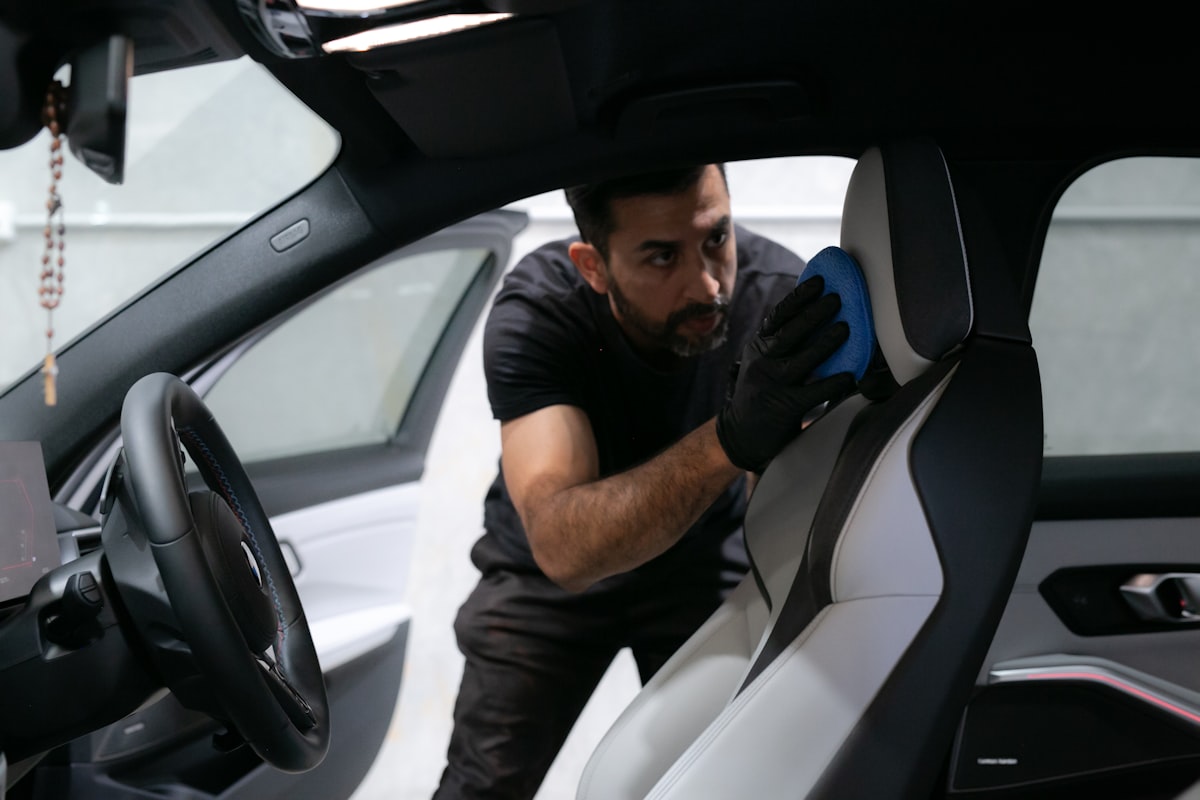
Short answer: Blot the stain immediately with a dry microfiber cloth and cold water only — never rub, and never use heat, which permanently sets protein-based stains like blood, milk, and egg. Match the cleaner to the material: a dilute upholstery cleaner and soft brush for fabric, a pH-balanced leather cleaner for leather or vinyl. Caught the same day, most stains come out completely. Once a spill has soaked into the foam beneath the seat or sat for weeks, a cloth can no longer pull it back out and it becomes a job for hot water extraction.
Almost every car seat stain gets worse because of what the owner does in the first five minutes. The instinct is to grab a napkin and scrub. That is the one thing guaranteed to make it permanent.
This guide covers the two rules that decide whether a stain comes out at all, then the specific method for each common stain type on both fabric and leather. At the end, an honest note on which stains are genuinely beyond a home fix.
The Two Rules That Decide Everything
1. Blot, never rub
Rubbing does three destructive things at once: it spreads the stain outward, it drives the liquid deeper into the foam beneath the fabric, and it abrades the fibre nap so that patch permanently catches light differently. Blotting lifts material out instead of pushing it in.
Press a clean, dry microfiber straight down, hold for a few seconds, lift, and move to a clean section of the cloth. Repeat with a fresh area of cloth every time. Always work from the outside of the stain inward, which stops it spreading into a wider ring.
2. Heat sets stains permanently
This is the rule people break most often. Protein-based spills — milk, blood, egg, most food — chemically set when heated, exactly like cooking an egg white. Once set, they are effectively dyed into the fibre.
So: cold water only until you are certain the stain is fully lifted. No steam, no hot water, no hair dryer, and do not leave the car closed up in the sun with a fresh spill on the seat. Save heat for the drying stage, after the stain is gone.
Fabric vs. Leather: Different Materials, Different Rules
Before you touch anything, identify what you are working on. Treating leather like fabric will strip its finish, and treating fabric like leather will barely clean it.
| Fabric / cloth | Leather / vinyl | |
|---|---|---|
| How it stains | Liquid absorbs into fibres and foam below | Sits on the surface coating, then soaks into seams and perforations |
| Moisture | Can take more, but never soak it | Use minimal moisture — never saturate |
| Tool | Soft brush to agitate, microfiber to blot | Soft brush only, very light pressure |
| Cleaner | Dilute upholstery cleaner or mild detergent solution | pH-balanced leather cleaner |
| Aftercare | Dry fully with airflow to prevent mildew odour | Condition after cleaning to stop cracking |
| Never use | Bleach, excessive water | Alcohol, bleach, melamine "magic" sponges |
Always test first. Pick a hidden spot — under the seat edge, low on the side bolster, or beneath the headrest — and test your cleaner there. Wait for it to dry fully before judging. Some fabrics lighten, and you want to discover that somewhere invisible.
The Stain-by-Stain Playbook
Coffee and tea
Blot up every bit of free liquid immediately with dry microfiber. Then mist lightly with cold water and keep blotting — you are diluting and lifting, not soaking. If colour remains, use a dilute upholstery cleaner, agitate gently with a soft brush, and blot again with a clean damp cloth. Coffee with milk is also a protein stain, so keep everything cold.
Grease, oil, and food
Do not add liquid first — that spreads oil. Cover the spot generously with baking soda or cornstarch and leave it for at least 15 minutes so it draws the oil up out of the fibres. Vacuum thoroughly, then treat the remaining shadow with a degreasing upholstery cleaner. Heavier grease often needs two rounds; that is normal.
Ink
On fabric, dab — never wipe — with isopropyl alcohol on a cotton swab, working from the outside in and switching to a fresh swab constantly so you are lifting ink rather than smearing it. Follow with a damp cloth to remove alcohol residue.
On leather, stop. Alcohol dissolves the protective topcoat and will leave a dull, discoloured patch that is more noticeable than the ink. Ink on leather is a professional job.
Blood
Blood is a protein stain, so the no-heat rule matters most here — hot water cooks it into the fibre the same way heat cooks an egg white. Rinse or blot with cold water only. On fabric, 3% hydrogen peroxide from the drugstore works well on a fresh spot: dab it on, let it fizz for a minute as it lifts the stain, then blot with a cold, damp cloth. Test on a hidden patch first — peroxide can lighten some dyed fabrics. Do not use peroxide on leather; it can bleach the finish, so stick to a leather-safe cleaner there. Blood that has already dried or set usually needs an enzyme cleaner to fully lift, the same category covered under pet accidents below.
Sunscreen
Deceptively difficult. The chemical UV filters in sunscreen can react with light-coloured leather and vinyl and leave an orange or yellow cast that is not really "dirt" at all. Act immediately: lift the residue with a dedicated leather cleaner and a soft brush. Once that discolouration has cured in the sun for weeks, it is often permanent, which is worth knowing before you scrub harder and damage the finish.
Pet accidents
Ordinary soap will not solve this, because it does not break down uric acid crystals. The visible mark may disappear while the odour stays — and your pet will still smell it and be drawn back to the same spot.
You need an enzyme cleaner, which digests the organic compounds rather than masking them. Apply enough to reach as deep as the accident went, which usually means more than feels comfortable, and let it dwell for the time on the label. Do not rush it with heat. If your car also has fur ground into the fabric, our pet hair removal guide covers that side of the problem.
Water rings and "clean spots"
The ring is not water — it is the dissolved dirt that migrated outward and dried at the edge. Spot-cleaning one small area often creates one of these, because you have cleaned a patch cleaner than everything around it.
The fix is to work the whole panel rather than the spot: lightly and evenly dampen the entire seat section, blot uniformly, and dry it evenly with airflow so nothing has a hard edge.
Never do these: mix ammonia-based and bleach-based cleaners (this produces toxic gas); use a melamine sponge on leather or vinyl; saturate a seat to the point the foam is wet; or use household all-purpose spray on leather. Also avoid leaving any seat damp overnight in a closed car — that is exactly how a musty smell starts, and then you are solving an odour problem instead of a stain.
Drying Properly (The Step Everyone Skips)
A seat that looks clean but stays damp inside is a future odour problem. Foam holds water far longer than the fabric surface suggests.
- Blot out as much moisture as you physically can with dry towels — pressing hard is fine here.
- Open the doors and get air moving across the seat. A fan pointed into the cabin works well.
- Park in sun with windows cracked only after the stain is fully gone.
- Do not close the car up until the seat is dry to the touch well below the surface.
When It Is Genuinely Beyond DIY
Home methods work on surface stains caught early. They struggle once a spill has soaked into the foam, because you cannot pull it back out with a cloth — and if you only dilute it, it wicks back to the surface as it dries. That is why a stain "comes back" days later.
Call it professional territory when:
- The stain is older than a few weeks, or has already been heat-set.
- It soaked through to the foam, or reappeared after drying.
- It covers a large area, or there are many spots across several seats.
- There is still an odour after cleaning — that means the source is still in there.
- It is ink, dye transfer, or sunscreen on light leather.
Our interior deep clean uses hot water extraction, which injects cleaning solution and immediately vacuums it back out along with the dissolved residue — the actual removal step a cloth cannot perform. Combined with enzyme treatment for organic stains and proper leather cleaning and conditioning, that is what resolves the stains this guide tells you to stop fighting.
We are fully mobile across the Bay Area, so this happens in your driveway or parking space — including townhome complexes with no outdoor water. For the full cabin process, see how to clean your car interior like a pro.
The products we actually use
Interior work lives or dies on chemistry. We use Chemical Guys interior cleaners and fabric shampoos for seats, carpet and mats, Meguiar's for leather cleaning and conditioning, and a dedicated Gyeon interior and glass line for trim and the inside of the windows. Every surface gets a pH-appropriate product rather than one all-purpose spray, because a degreaser strong enough for rubber floor mats will dry out leather and haze a dashboard.
Tools matter as much as chemicals: soft-bristle detail brushes for vents and seams, plush microfiber towels that get retired the moment they pick up grit, and separate towels for glass so nothing streaks. Professional-grade product on a dirty towel still scratches.
Frequently Asked Questions
Does baking soda actually remove car seat stains?
Baking soda is genuinely useful for absorbing fresh grease and for neutralizing odor, but it is not a stain remover on its own. Use it to pull up oil before it soaks in, vacuum it away completely, then treat the remaining discoloration with a proper upholstery cleaner.
Why did my stain come back after the seat dried?
That is wicking. Liquid soaked down into the foam padding, and as the seat dried the moisture travelled back up to the surface carrying the residue with it. It means the stain was diluted rather than extracted. Proper removal pulls the moisture and residue back out instead of pushing it deeper.
Can I use a Magic Eraser on leather car seats?
No. Melamine foam sponges work by abrasion, so on leather and vinyl they scrub away the protective topcoat and any factory colour finish. It may look better briefly, then that patch will absorb dirt faster and wear noticeably lighter than the rest of the seat.
When is a car seat stain beyond DIY?
When it has soaked into the foam, when it is older than a few weeks, when it covers a large area, or when it involves dye, ink, or a pet accident that still smells. Those need hot water extraction and enzyme treatment to remove the source rather than mask it.
Is hydrogen peroxide safe for car seat stains?
On fabric, yes for fresh blood and some organic stains — the fizzing action helps break the stain down before you blot it away, though you should still test it on a hidden spot first since it can lighten some dyed fabrics. Avoid it on leather, where it can bleach the finish, and never mix it with other cleaning chemicals.
Stains That Won't Budge?
Our mobile interior deep clean extracts what cloths can't reach — at your home or office.
Book an Interior Deep Clean →