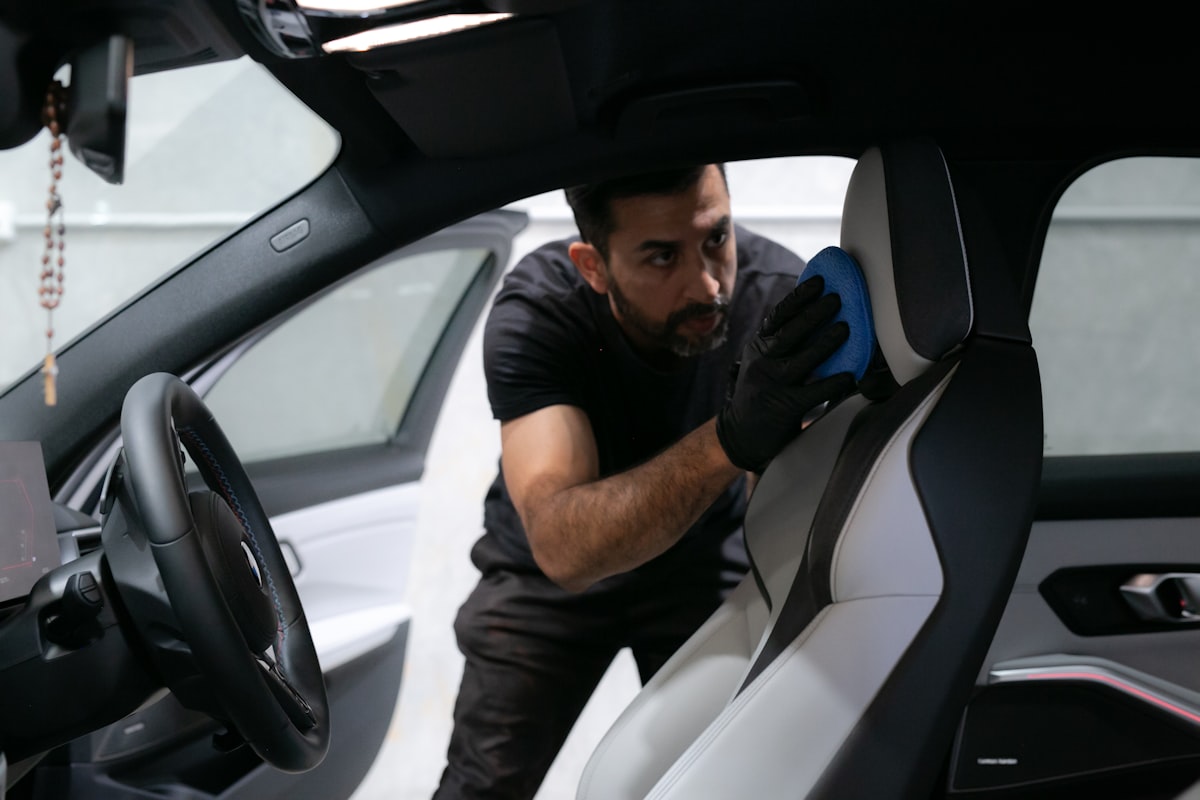
Short answer: Blot immediately, never rub. Use cold water for protein stains (coffee with milk, food, pet accidents). Match the cleaner to the material: dilute upholstery cleaner for fabric, pH-balanced leather cleaner for leather. Bay Area heat is a real factor — a stain left in a car parked in a San Jose surface lot over lunch can set before you get back. The sections below cover the specific method for each stain type and the point at which DIY stops working.
San Jose commuters spend a lot of time in their cars. The average tech worker driving from Willow Glen or Almaden Valley to a campus in Santa Clara or Sunnyvale is in the car 45 minutes to an hour a day. That is enough time for a travel mug to tip over on 87, for a lunch order from Santana Row to get into the passenger seat, or for a dog who just finished a run at Guadalupe River Park to climb into the back and redistribute trail mud and wet fur across the rear seats. See our full San Jose service page for neighborhood coverage and our San Jose pricing guide for what a professional interior clean runs.
This guide covers the practical method for getting those stains out, the specific mistakes that make them permanent, and the honest line between what a microfiber cloth solves and what requires a professional extraction.
Why San Jose Heat Matters for Car Seat Stains
Most stain-removal guides do not account for local conditions. San Jose does 80-plus-degree days from May through October, and a car parked in a surface lot near Santana Row, downtown, or a Caltrain park-and-ride can reach interior temperatures of 130 to 160 degrees Fahrenheit. Protein-based stains — coffee with milk, food, blood, and all pet accidents — set when heated, the same chemistry as cooking an egg white.
That means a stain that happens in the morning commute and sits closed in the car through an eight-hour workday in August may be functionally permanent by the time you open the door. The same stain that would have blotted out in five minutes at 8AM is significantly harder at 6PM. Treating it before you park, or at minimum before you close the car in the sun, is not overthinking it — it is just the physics of protein chemistry.
Never close a freshly stained car in San Jose afternoon sun. The heat will set protein stains, intensify odor from pet accidents, and permanently bond food residue to fabric fibers. If you cannot treat a stain on the spot, at least blot out as much free liquid as possible and leave a window cracked to reduce interior temperature until you can deal with it properly.
The Two Rules That Determine Whether a Stain Comes Out
Rule 1: Blot, never rub
Rubbing does three things simultaneously: it spreads the stain outward, drives the liquid deeper into the foam underneath the fabric, and abrades the fiber surface so that patch permanently catches light differently than the rest of the seat. A cloth pressed straight down, held for a few seconds, and lifted pulls material up and out. Always work from the edge of the stain inward so you are concentrating it rather than spreading it.
Rule 2: Match the chemistry to the stain and the material
A cleaner that works on fabric will dry out leather. A general all-purpose spray that works on countertops is typically too alkaline for upholstery and can discolor fabric or strip a leather finish. The table below shows how the approach changes by seat material:
| Fabric / cloth seats | Leather / vinyl seats | |
|---|---|---|
| Cleaner type | Dilute upholstery shampoo or a gentle fabric cleaner | pH-balanced dedicated leather cleaner |
| Water use | Can use more, but never saturate the foam | Minimal moisture — leather soaks through seams and perforations |
| Application tool | Soft brush to agitate, microfiber to blot | Soft brush only, very light pressure |
| After cleaning | Dry with airflow to prevent mildew odor | Condition immediately after cleaning to prevent cracking |
| Never use | Bleach, boiling water, melamine "magic" sponges | Isopropyl alcohol, bleach, melamine sponges (all strip the topcoat) |
Stain Difficulty by Age and Type
The Stain-by-Stain Method for San Jose Car Owners
Coffee and cold brew (the most common San Jose commute stain)
Black coffee: blot with dry microfiber immediately, mist lightly with cold water, keep blotting. Dilute upholstery cleaner if color remains. Coffee with milk or oat milk is a protein stain — keep everything cold. If it went into the car at 8AM and sat on 87 for 45 minutes, blot out as much as you can before you park. Do not add hot water, do not leave it sealed in the car, and do not use the seat warmer.
Pet accidents (Guadalupe River Park, Los Alamitos Creek Trail, Los Gatos Creek Trail)
San Jose has excellent dog walking options — Guadalupe River Park, the Los Alamitos Creek Trail in Almaden Valley, the Los Gatos Creek Trail through Campbell. Dogs get into cars after walks wet, muddy, and occasionally with worse. Ordinary soap and water do not solve a urine stain because they do not break down uric acid crystals. You need an enzyme cleaner, which digests the organic compounds rather than masking them. Apply enough to penetrate as deeply as the accident did, let it dwell for the full time on the label, and do not heat the area. If the seat still smells after drying, the source is still in the foam. Our pet hair removal guide covers the fur side of the same problem.
Food stains (Santana Row lunches, SJSU dining, East Side taquerias)
For grease or oil-based food: do not add liquid first. Apply baking soda or cornstarch to absorb oil before it soaks further, wait at least 15 minutes, vacuum thoroughly, then treat the remaining shadow with a dilute fabric degreaser. For non-greasy food: blot cold water first, then upholstery cleaner. Tomato sauce and sauces with dye can stain fabric quickly — act before they dry.
Sunscreen (a real problem on Bay Area leather)
UV filter chemicals in sunscreen react with light-colored leather and vinyl under sun exposure and can leave a permanent orange or yellow cast. It is not surface contamination — it is a chemical reaction. Act immediately: lift the residue with a dedicated leather cleaner and a soft brush. If it has cured in the sun for a week or more, the discoloration may not fully reverse. This is worth knowing before you scrub harder and risk damaging the leather finish.
Ink
On fabric: dab with isopropyl alcohol on a cotton swab, working from the outside in and switching to a clean swab constantly. Follow with a damp cloth to remove alcohol residue. On leather: do not use alcohol. It strips the protective topcoat and creates a dull patch that is more noticeable than the ink. Ink on leather is professional territory.
Water rings from a "clean" wipe
The ring is not water — it is the dirt that migrated outward as the moisture evaporated. Spot-cleaning a small area creates rings because you have cleaned one patch cleaner than everything around it. The fix is to work the entire panel, dampening and blotting uniformly, so nothing has a hard edge when it dries.
When to Stop and Call a San Jose Detailer
Home methods work on surface stains caught early. They run into limits quickly once a stain has soaked into the foam, because a cloth can dilute what is there but cannot pull it back out. As the foam dries, the moisture wicks back to the surface carrying the residue with it — the stain "comes back." That is not a failure of your cleaning; it is a physics problem that requires extraction.
Stop and call a professional when:
- The stain came back after the seat dried — it has soaked into the foam.
- It has been in the car through several days of San Jose heat and is fully set.
- There is still an odor after cleaning — the source is still in the material.
- It covers a large area or multiple seats.
- It is ink or dye on light leather, or sunscreen that has been heat-cured.
Our interior deep clean uses hot water extraction: inject cleaning solution, immediately vacuum it back out along with dissolved contamination. It removes the source rather than diluting it. For a full overview of what a thorough cabin clean covers, see how to clean your car interior like a pro. For odor problems specifically, the car smell guide covers what works and what only masks the problem.
We are mobile throughout San Jose — including Willow Glen, Almaden Valley, Evergreen, Berryessa, and downtown — and also operate our Santa Clara location at 1850 Warburton Ave if mobile service is not possible at your address.
The products we actually use
Interior chemistry on every job comes from the same confirmed line. Fabric seats and carpet get Chemical Guys upholstery cleaner and interior products, applied with soft-bristle detail brushes to agitate gently without abrading the fiber. Leather is cleaned with Meguiar's dedicated leather cleaner and followed immediately with Meguiar's leather conditioner — skipping conditioning after cleaning is what causes leather to crack over time.
Glass and interior trim use Gyeon glass and interior products. Tool discipline matters as much as chemistry: glass towels are never used on upholstery, wheel brushes never touch body panels, and detail brushes are cleaned between surfaces so nothing cross-contaminates.
Our scope is interior work: extraction, cleaning, and conditioning. We do not apply nano or multi-layer protective coatings, perform abrasive paint restoration, install clear protective film, or tint windows. Interior extraction and conditioning is what we do for the cabin.
Frequently Asked Questions
What is the fastest way to remove a fresh coffee stain from a car seat?
Blot immediately with a dry microfiber cloth — press straight down, do not rub. Remove as much free liquid as you can, then mist lightly with cold water and keep blotting. Only after you have removed as much as possible with blotting should you apply a dilute upholstery cleaner and agitate gently with a soft brush. The biggest mistake is scrubbing first, which spreads the stain and drives it deeper into the foam.
Does the San Jose heat make car seat stains harder to remove?
Yes. Protein-based stains — coffee with milk, food, pet accidents — set faster when heat is applied. A car parked in a San Jose surface lot in summer can reach interior temperatures of 130 to 160 degrees Fahrenheit. A spill left in a closed car through an afternoon in that heat may be permanently set by the time you open the door. If a stain happens on the way into a long meeting, treat it before you park rather than after.
How do I remove pet stains from car seats from a dog walk at Guadalupe River Park?
Regular soap or upholstery cleaner will not fully solve a pet accident because it does not break down uric acid crystals. You need an enzyme cleaner, which digests the organic compounds. Apply enough to penetrate as deeply as the accident went, let it dwell for the full time on the product label, and do not rush it with heat. If you can still smell it after the seat dries, the source is still in the foam — that requires extraction.
When should I call a San Jose detailer instead of cleaning the seats myself?
Call a professional when the stain has soaked into the foam and wicked back up after drying, when it is older than a few weeks, when it covers a large area or multiple seats, or when there is still an odor after your cleaning attempt. A professional interior deep clean uses hot water extraction to pull contamination out of the foam rather than diluting it into the padding.
Is there somewhere in San Jose I can drop off my car for an interior deep clean?
Yes. XN Car Detailing operates a location at 1850 Warburton Ave, Santa Clara, CA 95050 — about 10 minutes from central San Jose. We also come to you: mobile interior deep cleans are available throughout San Jose including Willow Glen, Almaden Valley, Evergreen, and Berryessa, as long as there is access to an outdoor water spigot and power outlet.
What is the difference between wiping a stain and extracting it?
Wiping with a damp cloth dilutes surface contamination but does not remove what has soaked into the seat foam. As the foam dries, moisture wicks back to the surface carrying the residue with it — this is why a stain can appear cleaned and then reappear days later. Extraction injects cleaning solution and immediately vacuums it back out along with dissolved contamination, pulling the source out rather than pushing it deeper.
Interior Deep Clean in San Jose
Mobile service throughout San Jose. Drop-off available in Santa Clara. Seats, carpet, stains, odor — all of it.
Book an Interior Deep Clean →